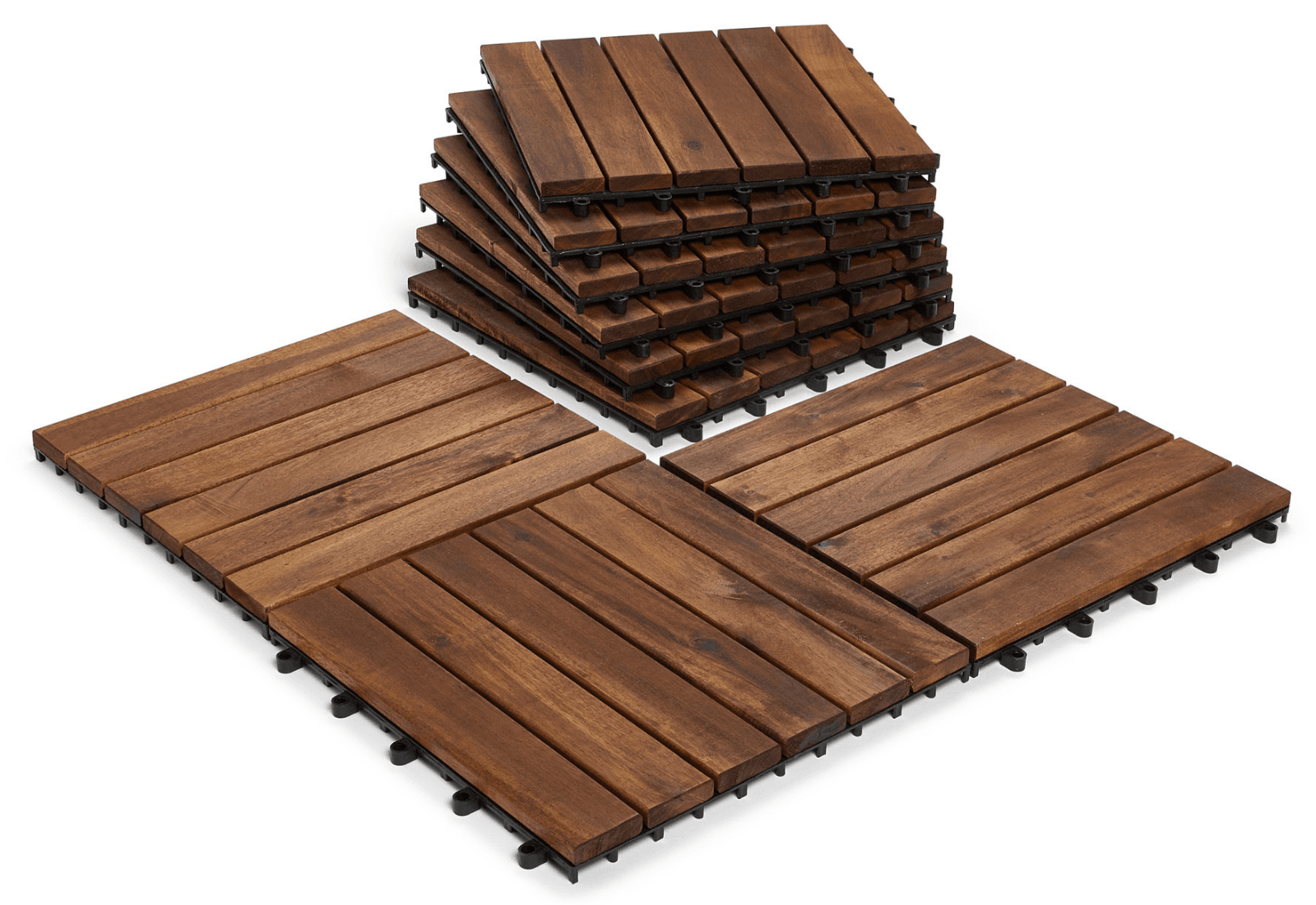
If you are lucky enough to have a balcony in your rental flat, it probably looks terrible.
Most UK balconies feature stained, grey concrete or cheap, slippery paving slabs. They are cold, uninviting, and impossible to keep clean.
You want to turn it into a cozy outdoor retreat for summer evenings. But you are a renter. You cannot lay ceramic tiles with grout. You cannot paint the concrete. You cannot glue anything down.
The ultimate renter loophole? Interlocking Decking Tiles.
These are modular squares (usually 30x30cm) that simply “click” together like a giant jigsaw puzzle. They sit on top of your existing balcony floor, held in place by their own weight and the interlocking mechanism. Zero glue. Zero screws.
When you move out, you unclip them, put them in a box, and your landlord’s ugly concrete is exactly as you found it.
We reviewed the best-selling options on Amazon UK to see which ones survive the British rain, which ones are easiest to cut around tricky corners, and which ones won’t trap water and cause structural rot.
Visual Comparison: The Floor Upgrades
| Spec |
🌳
CLICK-DECK Hardwood(Acacia) |
🔥
WOLTU WPC Composite
|
🌿
Interlocking ArtificialGrass |
|---|---|---|---|
| Best For | The Authentic “Scandi” Look | Zero Maintenance | Soft Underfoot / Pets |
| Material | Real Acacia Wood | Wood-Plastic Composite | Synthetic Turf |
| Maintenance | Needs annual oiling | Wipe clean only | Hose down |
| Pack Size | 12 Tiles (Approx 1 sqm) | 11 Tiles (Approx 1 sqm) | 6 Tiles |
| Renter Rating | ★★★★★ | ★★★★★ | ★★★★☆ |
1. The Classic Pick: CLICK-DECK Hardwood Decking Tiles
If you want the warmth and aesthetic of a real wooden deck, CLICK-DECK is the undisputed market leader in the UK.
Why It’s Renter Friendly
- Acoustic Damping: Real wood absorbs sound better than hard plastic. If you have noisy neighbours below, or want to dampen the sound of your own footsteps on the balcony, these heavy wood tiles help soften the noise.
- The Look: Acacia wood is beautiful. It instantly transforms a cold, concrete slab into something resembling a high-end spa or hotel terrace.
Pros:
- Made from durable, sustainably sourced Acacia wood.
- Incredibly easy click-together mechanism.
- The wood slats provide natural anti-slip grip.
Cons:
- Maintenance Required: It is real wood. To keep the rich brown colour in the UK weather, you must apply a coat of decking oil once a year, otherwise, it will weather to a silvery-grey.
2. The “Zero Effort” Pick: WOLTU WPC Composite Decking
If you love the look of wood but hate DIY maintenance, you need WPC (Wood Plastic Composite). The WOLTU tiles mix recycled wood fibres with plastic polymers.
Why It’s Renter Friendly
- Indestructible: WPC does not rot, splinter, warp, or fade significantly in the sun. You never have to oil it. You literally lay it down and ignore it.
- Easy Cleaning: Because it is part plastic, algae and winter grime don’t penetrate the surface. You can clean it easily with a Cordless Pressure Washer.
Pros:
- 100% maintenance-free.
- Available in modern colours (like Light Grey and Charcoal) to match contemporary flats.
- Splinter-free (safe for bare feet).
Cons:
- Can get quite hot underfoot if exposed to direct, blazing afternoon sun.
- Lacks the “natural” variation of real wood grain.
3. The “Garden” Pick: Artificial Grass Interlocking Tiles
Missing the feeling of a lawn? You can build one. These tiles feature a layer of synthetic turf attached to the same plastic interlocking base as the wooden tiles.
Why It’s Renter Friendly
- The “Checkerboard” Hack: Because these often use the same interlocking pin system as wooden tiles, a massive trend on Pinterest is to mix and match them. You can create a “checkerboard” pattern of wood and grass, or have a wooden dining area leading to a grassy “lawn” area on your balcony.
- Pet Friendly: If you have a dog in a high-rise flat, these provide a comfortable surface for them to lie on in the sun.
Pros:
- Instantly softens a harsh concrete balcony.
- Very forgiving on uneven surfaces compared to rigid wood.
- Great for bare feet.
Cons:
- Requires more cleaning (leaves and debris get stuck in the grass fibres; needs vacuuming or brushing).
- Cheaper versions can look very “plastic” up close.
Annotated Manual: The “Drainage” Imperative
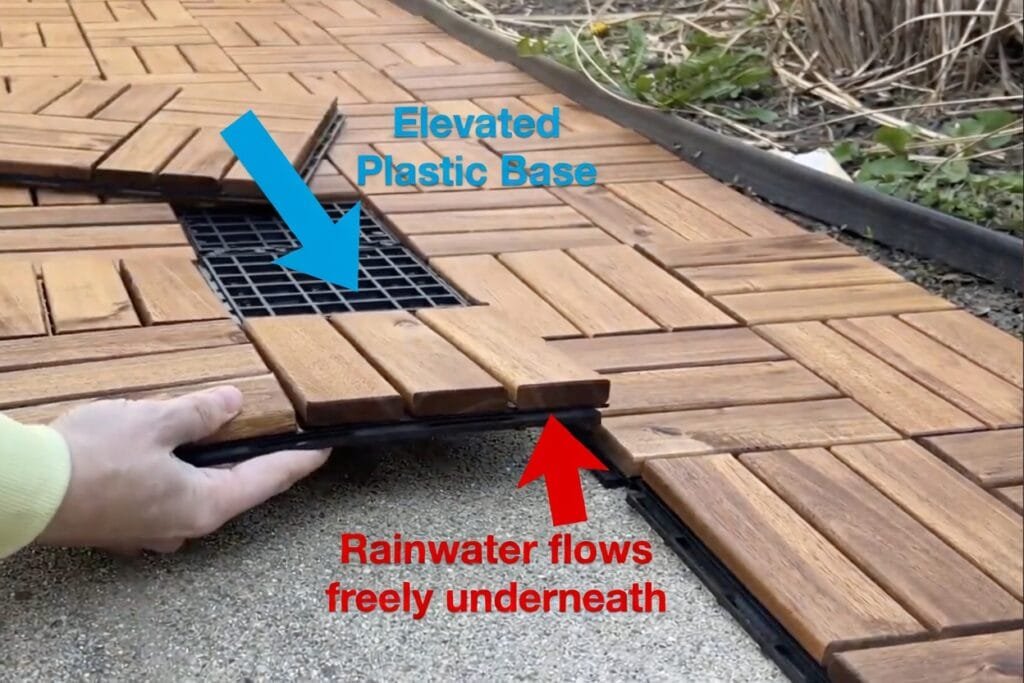
The biggest mistake renters make is laying outdoor rugs or solid rubber mats flat on their balcony floor.
Why is this bad? It traps rainwater against the concrete. The water stagnates, breeds black mould, and eventually damages the waterproof membrane of the building. When you move out, lifting that rug will reveal a permanent black stain.
The Fix: The Plastic Grid Base
As you can see in the photo above, true interlocking tiles feature a raised plastic grid underneath the surface material.
How Our Balcony Deck Tiles Work
The 1cm Lift
The plastic grid holds the wooden (or composite) slats about 1 to 2 centimetres above the concrete. This prevents the wood from sitting in puddles and rotting.
The Flow Channel
When it rains, the water falls through the gaps in the top surface. Because the base is an open grid, the rainwater flows freely underneath the tiles, following the natural slope of the balcony towards the drainage pipe.
The “Click” Assembly
You do not need tools. The plastic tabs on the edge of one tile simply snap into the loops on the next tile.
Real-World Reality: Community Feedback
We checked the DIYUK subreddit to see how these tiles hold up in British weather.
MAINTENANCE
1. “The Wind Lift”
USER REPORT
“I plugged the Ninja Woodfire into an extension lead with my outdoor lights and laptop. The whole flat went dark.”
💡
The Smart Tenant Fix
These tiles rely on gravity. If you live very high up or on a coastal, high-wind balcony, the wind can lift them if they aren’t secured.
Our Advice
If you are exposed to high winds, use heavy ceramic plant pots in the corners to weigh the edges down. Alternatively, you can use a few dabs of heavy-duty outdoor sealant in the corners (it is easy to scrape off the concrete later, unlike full-floor adhesive).
MAINTENANCE
2. “The Slippery Slats”
USER REPORT
“I bought the composite (WPC) tiles. In November, they got covered in a thin layer of algae and became an ice rink.”
💡
The Smart Tenant Fix
WPC is less porous than wood, meaning water sits on top of it longer, promoting surface algae in winter.
Our Advice
You must clean them. Give them a stiff brush with warm soapy water (or use a pressure washer) twice a year (Autumn and Spring) to remove the invisible layer of grime that causes the slipperiness.
Frequently Asked Questions
How many boxes do I need?
Measure your balcony in metres (Length x Width) to get the Square Metre ( m2 m 2 ) area. For example, 3m x 1.5m = 4.5 m2 m 2 . One box of 11-12 tiles usually covers exactly 1 m2 m 2 . Therefore, you would need 5 boxes. Always order 1 extra box to account for mistakes when cutting edges.
Can I lay these on an uneven balcony?
They require a reasonably flat surface. If your balcony has deep dips or large bumps, the interlocking clips will snap under the pressure of you walking on them. They work perfectly on standard flat concrete, asphalt, or existing flat tiles.
Will weeds grow through the gaps?
If you lay them on a concrete balcony, no. If you are laying them over soil or an old patio in a ground-floor garden flat, you must lay down a “Weed Control Fabric” membrane first, otherwise weeds will grow up through the gaps in the plastic grid.
Verdict: Which Tiles for Your Terrace?
- Best for the Premium Look: CLICK-DECK Hardwood. If you don’t mind spending 30 minutes a year oiling them, real acacia wood looks unbeatable and adds real warmth to a space.
- Best for Lazy Gardeners: WOLTU WPC Composite. The ultimate renter choice. Lay them down, forget about them, and enjoy a modern, splinter-free floor.
- Best for Comfort: Artificial Grass Tiles. Perfect for turning a harsh concrete slab into a soft space for morning yoga or pets.